Un poco de historia para empezar, Padre: ¿cómo
conoció la Tradición y a Monseñor Lefebvre?
En
1968, estando en Argentina, visité al Arzobispo de Paraná, quien me dijo: “¿quieres
defender la Tradición? En el concilio la defendí junto a un Obispo valiente,
amigo mío, Mons. Marcel Lefebvre”. Fue la primera vez que escuché hablar de Mons.
Lefebvre. Fui en busca de Mons. Lefebvre a Suiza en 1972, para la Semana Santa
y ahí lo conocí.
¿Dónde nació? ¿Por qué estaba usted viviendo en
Sudamérica?
Nací
en Argelia y mi familia, después de la independencia, adquirió un campo en Argentina,
cerca de Paraná. Mi familia fue expulsada de Argelia porque el gobierno francés
entregó el poder a los combatientes musulmanes que realizaron masacres
espantosas en el curso del proceso de independencia. Mis abuelos, padres y tíos
eran agricultores allá desde 1830.
Me
ordenó Mons. Lefebvre en 1977, en Econe, y a los 15 días lo acompañé en una
gira por el Sur de EE.UU., México (donde el Gobierno nos impidió la entrada),
Colombia, Chile y Argentina. Monseñor me encargó empezar el apostolado en esa
región. El primer año me ayudaron dos sacerdotes argentinos y, el año
siguiente, otro español (de la FSSPX). Se creó, en seguida, el Distrito de América
del Sur, a mi cargo, y empecé a predicar retiros hasta México. Hubo, el primer
año, como 12 vocaciones que se instalaron en el Priorato de Buenos Aires, que estaba
en una casa bastante grande. En seguida, por 1980, se construyó el seminario de
La Reja (Buenos Aires), del cual Mons. Lefebvre me nombró director. Ahí me quedé hasta 1985, cuando me nombraron
superior del Distrito de México. Entonces se construyeron las iglesias de la
capital y de Guadalajara. Atendía con los Padres Calderón, Anglés y Tam, los distintos
lugares de ese país. Luego estuve unos pocos años en Francia. Posteriormente
fui nombrado en el seminario de Argentina como profesor de historia y ahí
estuve hasta la expulsión de Mons. Williamson de la Argentina (2009).
¿Confiaba Mons. Lefebvre en usted?
Monseñor
me dio libre acceso a su correspondencia y me encargó ciertos expedientes. Me
tenía cierta confianza: en 1977 me preguntó, en Albano, qué opinaba sobre las
consagraciones. En otra oportunidad, en 1977 también, me confidenció. “ellos me
están esperando” (el director de Econe y los profesores). Ellos sugerían
aceptar la Misa Nueva y el concilio para conservar la Misa Tridentina. Decían
le decían: “ahora estamos confrontados con Roma. Si queremos conservar la Misa
(Tridentina) debemos aceptar el concilio”. Pretendían que Monseñor se jubilara
en una hermosa casa en Alemania, pero él les respondió que eran libres de irse
si lo deseaban. Los echó.
¿Es efectivo que Mons. Lefebvre le pidió a usted que aceptara
ser consagrado?
En
1986, estando de visita en Econe, me tomó aparte luego de una comida y me
preguntó si yo aceptaría ser consagrado Obispo. Conociendo lo que siguió, tal
vez debí aceptar.
¿Entonces usted no aceptó?
Le
dije que me parecía que Mons. de Galarreta sería más indicado.
¿Puede sintetizar lo sucedido en el 2012?
Ese
año estuvimos a muy pocos pasos del acuerdo y fracasó a último momento, probablemente,
por el asunto Williamson. El acuerdo fracasó por ese asunto y por la carta de
los 3 Obispos. Ambas cosas hicieron fracasar el acuerdo.
Se dice que la clave de la estrategia ad intra de Monseñor Fellay, está en
tener el respaldo del Capítulo General. ¿Puede decirnos algo sobre eso?
El
capítulo general fue muy bien preparado por Mons. Fellay y ellos (los
acuerdistas) lograron sus objetivos. Ahí entendí lo que le pasó a Monseñor
Lefebvre y a sus amigos en el concilio Vaticano II. Él (Mons. Fellay) había
tomado la decisión de una política de aproximación a Roma y se las arregló para
tener el apoyo general del capítulo expulsando a Mons. Williamson, que era el único capaz de
obstaculizar esa política.
¿Cuáles, a su juicio, deben ser las condiciones
requeridas para hacer un acuerdo con Roma?
Mons.
Lefebvre nos dijo que mientras no haya un cambio radical en Roma, un acuerdo es
imposible, porque esas personas no son leales, y uno no puede pretender transformar
a los superiores. Es el gato el que come al ratón y no el ratón el que come al
gato. Un acuerdo equivaldría a entregarse en manos de los modernistas, por
consiguiente, se debe rechazar absolutamente. Es imposible. Hay que esperar que
Dios intervenga.
¿Puede decirnos lo que piensa de las visitas de
evaluación de diversos prelados modernistas a los Seminarios de la Fraternidad?
Es verdad que alguna vez Mons. Lefebvre recibió algunos prelados. ¿Cuál es la
diferencia ahora?
Se
trataba de visitas excepcionales en las cuales el Card. Gagnon nunca tuvo la
posibilidad de defender el concilio, mientras que ahora se trata de los primeros
pasos en la reintegración (de la FSSPX) a la iglesia conciliar.
¿Qué opina de un eventual reconocimiento unilateral
por parte de Roma a la FSSPX?
Es
una trampa.
Entre el capítulo del 2006 y la crisis iniciada el
2012, se observa un cambio de actitud de las autoridades de la FSSPX respecto de
Roma. ¿A qué se debe ese cambio?
A
la decisión de los superiores de reintegrase a la iglesia conciliar. Desde 1994
o 1995 se realizaron los contactos del GREC, que fueron pasos significativos hacia
la reconciliación, como lo había previsto el embajador Pérol (representante de Francia
en Italia), que es el inventor del levantamiento de las excomuniones (2009) y del
Motu Proprio (2007). Eso debía tener como contrapartida el reconocimiento del concilio.
¿Qué haría Mons. Lefebvre en la situación actual?
Seguiría
en la línea que nos indicó después de las consagraciones, descartando absolutamente
la eventualidad de un acuerdo.
Si en el futuro usted fuera invitado a ir a Roma a
conversar con el Papa, ¿iría?, ¿qué le diría?
En
primer lugar, consultaría a todos nuestros amigos de la Resistencia. Iría con Mons.
Williamson y otros excelentes sacerdotes que llevan el combate de la Resistencia
con mucho valor. Y mantendría informados a todos nuestros amigos, con toda
transparencia.
Mons. Fellay ha dicho que la FSSPX está de acuerdo
con el 95% del concilio Vaticano II. ¿Qué opina de eso?
Mons.
Lefebvre contestó que todo el concilio está invadido de un espíritu subjetivista
que no es católico.
Francisco, siendo un eficaz
demoledor de la Iglesia y destructor objetivo de la fe, ¿es verdadero Papa?
En mi opinión, no se puede decir que Francisco es peor
que Pablo VI, que fue quien puso a la Iglesia en otra vía; y entonces debemos
conservar la actitud que fue la de Mons. Lefebvre, actitud prudencial que
excluye el sedevacantismo. Mons. Lefebvre siempre se rehusó a ordenar un
seminarista que fuera sedevacantista. Y esa fue la política de la FSSPX hasta la
muerte de él. Así que no nos vengan con que Monseñor dijo esto o lo otro.
¿Cuál es el estado de su proceso de expulsión de la
FSSPX?
Las
últimas noticias fueron que encontré, en el correo-e, por casualidad, una
segunda monición. Desde mañana, entonces, la FSSPX tendrá cuatro Obispos nuevamente.
¡Deben echarme rápidamente!, ¡Deo gratias!
Esta decisión de consagrarlo obispo debe haber sido
muy sopesada y meditada durante mucho tiempo. Al igual que Mons. Lefebvre,
usted, Mons. Williamson y los sacerdotes de la Resistencia no han querido ser
colaboradores de la destrucción de la Iglesia. Es por conservar la fe intacta
que han sido perseguidos, condenados y calumniados muchas veces. Su
consagración episcopal le podrá acarrear una pretendida excomunión. ¿Cuáles
fueron las razones principales para llevar a cabo esta consagración?
La
razón principal es que no podemos dejar la Resistencia sin Obispos. Como lo
dijo Mons. Lefebvre, son indispensables Obispos católicos para la conservación
de la verdadera doctrina de la fe y los sacramentos.
Mons. Lefebvre pensó en usted para ser consagrado
Obispo y ahora Mons. Williamson ha podido cumplir ese deseo. ¿Cuál será su principal
preocupación?
Esforzarme
en mantener la obra de Mons. Lefebvre en el camino que él había trazado, sin
desviarse ni a la derecha ni a la izquierda.
¿Cuál será su lugar de residencia?
Francia,
donde hemos previsto abrir un seminario cerca de los Dominicos de Avrillé.
¿Le gustaría decir algunas palabras a los sacerdotes
y fieles, que aún están bajo la estructura de la Fraternidad, pero que están
inquietos debido a la deriva liberal de ella en los últimos años?
Que
vuelvan a leer y a meditar los textos de su fundador.
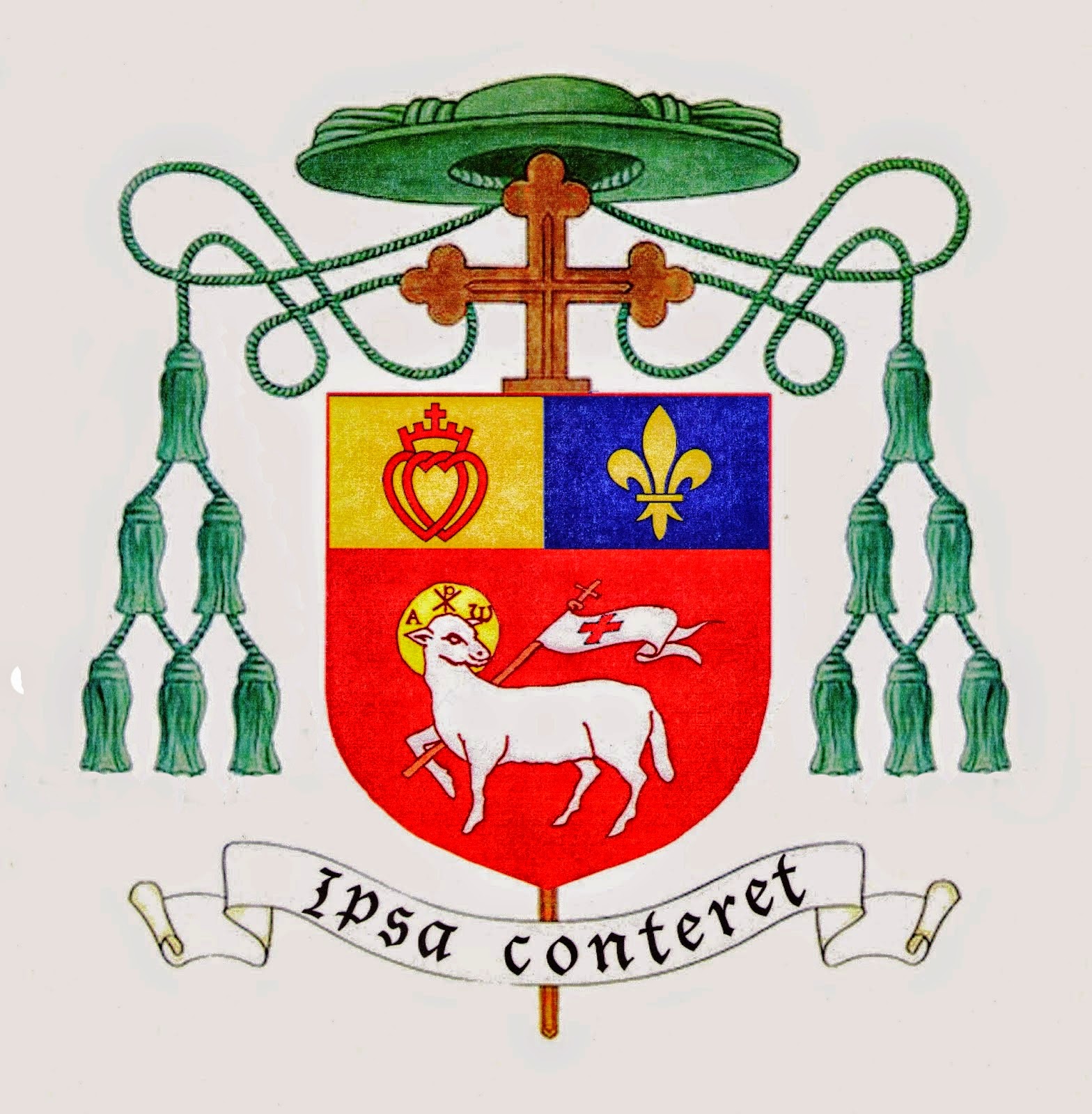
¿Nos puede explicar lo esencial de su escudo?
En
el centro está el Cordero del Apocalipsis, el Alfa y Omega, el Cordero de Dios
que quita el pecado del mundo, anunciado por Isaías. Los corazones recuerdan La
Vendée mártir de la Revolución y la flor de lis es emblema de la Francia católica.
El lema, ipsa cónteret (ella te
aplastará) está tomado de la Vulgata, Génesis 3, 15, dónde Dios promete la
victoria de la Virgen María sobre el dragón.
¿Hay algo más que quisiera agregar?
Conservemos la fe, la esperanza y la caridad. No hay
que dudar y hay que pedir eso a Dios y a nuestra Señora, que nos mantengan en
esas virtudes.
Padre, agradecemos profundamente a Dios, a su Santísima Madre, y a San José Protector
de la Iglesia, por esta gracia tan grande. Pedimos por usted para que Dios lo
conserve y lo guarde. Le agradecemos a usted por haber aceptado tan tremenda
carga y a Monseñor Williamson por haberlo consagrado como sucesor de los
Apóstoles. Deo Gratias!
English
de la Iglesia, por esta gracia tan grande. Pedimos por usted para que Dios lo
conserve y lo guarde. Le agradecemos a usted por haber aceptado tan tremenda
carga y a Monseñor Williamson por haberlo consagrado como sucesor de los
Apóstoles. Deo Gratias!
English
|
Translated by Michael cruzadoparalaverdad@gmail.com
|
Exclusive Interview with Fr. Faure
How about a little history to begin, Father: how did
you get to know Tradition and Archbishop Lefebvre?
In 1968, in Argentina, I visited the Archbishop of
Paraná, who said to me: “Do you want to defend Tradition? At the Council I
defended it together with a brave Bishop, a friend of mine, Archbishop Marcel
Lefebvre.” That was the first time I had heard of Archbishop Lefebvre. I went
to look for Archbishop Lefebvre in Switzerland in 1972, during Holy Week and
there I met him.
Where were you born? Why were you living in South
America?
I was born in Algeria and my family, after
independence, acquired a plot of land in Argentina, close to Paraná. My family
was deported from Algeria because the French government
surrendered power to the militant Muslims who committed horrendous massacres
during the course of the process of the independence. My grandparents, parents
and uncles were farmers there since 1830.
Returning to the story, how your apostolate in the
Society come about?
Archbishop Lefebvre ordained me in 1977 in Écône, and
15 days later I accompanied him on a trip through the southern United States,
Mexico (where the government refused our entry), Colombia, Chile, and
Argentina. The Archbishop put me in charge of starting-up the apostolate in
this region. During the first year two Argentinian priests helped me and the
following year another Spanish priest (of the SSPX). After this the South
American district was created with myself in charge and I began to preach
retreats as far north as Mexico. In the first year about 12 vocations were put
up in the Buenos Aires priory, which was in a large enough house. Then by 1980
the seminary of La Reja (Buenos Aires) was built, where Archbishop Lefebvre
appointed me rector. There I stayed until 1985, when I was named superior of
the District of Mexico. That was when we built the churches in Mexico City and
Guadalajara. I looked after the different parts of this country together with
Frs. Calderon, Angles, and Tam. Then I spent a few years in France. After that
I was appointed to the Seminary in Argentina as a history professor and I was
there until the expulsion of Bishop Williamson from Argentina (2009).
Did Archbishop Lefebvre confide in you?
Archbishop Lefebvre gave me free access to his mail
and correspondence and he put me in charge of certain cases. He had a certain
kind of trust for me: in 1977 in Albano he asked me what I thought about
consecrations. On another occasion, also in 1977, he confided to me “They
are waiting for me” (the rector professors of Écône). They would suggest
accepting the New Mass and the Council in order to preserve the Tridentine Mass.
They said to him: “Now we are in confrontation with Rome. If we want to
preserve the (Tridentine) Mass we must accept the Council.” They wanted the
Archbishop to retire to a beautiful house in Germany, but he told them that
they were free to leave if they wanted to. He threw them out.
Is it true that Archbishop Lefebvre asked you to
accept being consecrated a bishop?
In 1986, while on a visit to Écône, he called me aside
after a meal and asked me if I would accept being consecrated a bishop. In view
of what happened, maybe I should have accepted.
So you did not accept?
I told him that I thought Bishop De Galarreta would be
more suitable.
Can you summarize what happened in 2012?
In that year we were very close to an agreement and it
failed at the last moment, probably, due to the Williamson affair. The
agreement failed because of that matter and the letter of the three bishops.
Both of those things undermined the agreement.
It is said that the key to Bishop Fellay’s ad intra
strategy was getting the backing of the General Chapter. Can you tell us
something about that?
The General Chapter was very well prepared by Bishop
Fellay and the they (the accordistas) achieved their objectives. That was when
I understood what had happened to Archbishop Lefebvre and his friends at the
Second Vatican Council. He (Bishop Fellay) had decided on a policy of getting
closer to Rome and he managed to get the general support of the Chapter in
expelling Bishop Williamson, who was the only one capable of obstructing this
policy.
What, in your opinion, should be the conditions
required for making an agreement with Rome?
Archbishop Lefebvre told us that as long as there were
no real changes in Rome a deal would be impossible, because these people were
not loyal, and one cannot expect to change one’s superiors. It is the cat that
chases the mouse and not the mouse that chases the cat. An agreement would be
tantamount to handing oneself over into the hands of the modernists, and thus
it must be absolutely rejected. It is impossible. We must wait for God to
intervene.
Can you tell us what you think the preliminary visits
of various modernist prelates to the Seminaries of the Society? Is it true that
once Archbishop Lefebvre received some prelates? What is the difference now?
These were exceptional visits during which Cardinal
Gagnon never had the opportunity of defending the Council, whereas these visits
now are the first steps of a reintegration (of the SSPX) into the conciliar
church.
How do you view an eventual unilateral recognition of
the SSPX on the part of Rome?
It is a trap.
Between the 2006 chapter and the start of the crisis
in 2012, a change of attitude by the SSPX authorities towards Rome can be seen.
What is the reason for this change?
It is due to the SSPX superiors’ decision to
“reintegrate” themselves into the conciliar church. Since 1994 or 1995 the GREC
meetings took place which were significant steps towards a reconciliation, as
intended by ambassador Pérol (French ambassador in Italy), and he was the
inventor of the lifting of the excommunications (2009) and the Motu Proprio
(2007). That must be matched by a recognizing of the Council.
What would Archbishop Lefebvre do in the current
situation?
He would continue along the path that he showed us
after the consecrations, absolutely discarding any possibility of
an agreement.
If in the future you were invited to go to Rome and
speak with the Pope, would you go? What would you say?
First, I would consult with all our friends in the
Resistance. I would go with
Bishop Williamson and the other
excellent priests who are fighting the Resistance combat with great courage.
And I would keep all our friends well-informed with total transparency.
Bishop Fellay has said that the SSPX agrees with 95%
of Vatican II. What do you think of that?
Archbishop Lefebvre answered that the whole Council is
imbued with a subjectivist spirit that is not Catholic.
Francis is proving an effective demolisher of the
Church and objective destroyer of the Faith. Is he a true pope?
In my opinion, it cannot be said that Francis is worse
than Paul VI, who first steered the Church onto a new course, and so we must
preserve the attitude of Archbishop Lefebvre, a prudential attitude that
excluded sedevacantism. Archbishop Lefebvre always refused to ordain a
seminarian who was sedevacantist. And that was the policy of the SSPX until his
death. So don’t come to us with: “The Archbishop said this or said that.”
What is the state of your process of expulsion from
the SSPX?
The latest update is that I found in an email, by
accident, a second monition.
From tomorrow,
therefore, the Society of St. Pius X will again have four bishops! They had
better throw me out quickly! Deo gratias!
This decision of consecrating a bishop must’ve been
pondered and meditated on for a long time. Just like Archbishop Lefebvre, you,
Bishop Williamson and the priests of the Resistance did not want to be
collaborators in the destruction of the Church. It is to preserve the Faith
intact that you have been persecuted, condemned and slandered so many times.
Your episcopal consecration may earn you an alleged excommunication. What were
the main reasons for carrying out this consecration?
The main reason is that that we cannot leave the
Resistance without bishops. Just like Archbishop
Lefebvre said, Catholic bishops are indispensable for the preservation of the
true doctrine of the Faith and the sacraments.
Archbishop Lefebvre thought about consecrating you a
bishop and now Bishop Williamson is able to
fulfil that wish. What will be your main concern?
Striving to maintain the work of Archbishop Lefebvre
on the path he traced, without deviating to the right or to the left.
Where will your place of residence be?
In France where we plan to open a seminary close to
the Dominicans of Avrillé.
Would you like to say any words to the priests and
faithful that are still inside the structure of the Society but who are worried
by the liberal drift of the last few years?
Let them re-read and meditate upon the texts of their
founder.
Can you explain to us the essence of your coat of
arms?
In the centre is the Lamb of the Apocalypse, the Alpha
and the Omega, the Lamb of God who takes away the sins of the world, announced
by Isaiah. The hearts recall the Vendeé martyrs of the revolution and the Fleur
de Lys is the emblem of Catholic France. The motto, “ipsa cónteret” (“she shall
crush”) is taken from the Vulgate, Genesis 3,15 where God promises the victory
of the Virgin Mary over the dragon.
Is there anything else you would like to add?
Let us preserve Faith, Hope, and Charity. We must not
doubt and we must ask God and Our Lady to keep us in these virtues.
Father, we give deepest thanks to God, to His Most
Holy Mother, and to St. Joseph protector of the Church for this great grace. We
pray God that He preserve and keep you. We thank you for having accepted this
tremendous burden and we thank Bishop Williamson for consecrating you as one of
the successors of the Apostles. Deo Gratias!
Un peu d’histoire pour commencer. M. l’abbé, comment avez-vous rencontré Mgr Lefebvre et la Tradition ?
En 1968, en étant en Argentine, je suis allé visiter l’Archevêque du Parana, qui m’a dit : « Veux-tu défendre la Tradition? Au Concile, elle a été défendue par un Évêque courageux, mon ami, Mgr Marcel Lefebvre ». C’était la première fois que j’entendais parler de Mgr Lefebvre. Je suis allé à la recherche de Mgr Lefebvre en Suisse en 1972 à Pâques et l’y ai rencontré.
Où êtes-vous né ? Pourquoi viviez-vous en Amérique du Sud ?
Je suis né en Algérie et ma famille, après l’indépendance, a acquis un terrain en Argentine, près du Parana. Ma famille a été expulsée d’Algérie parce que le gouvernement français a livré le pouvoir aux combattants musulmans qui ont accompli des massacres épouvantables au cours du processus d’indépendance. Mes grands-pères, parents et des oncles étaient agriculteurs là-bas dès 1830.
En continuant avec l’histoire, comment avez-vous développé votre apostolat dans la FSSPX ?
J’ai été ordonné par Mgr Lefebvre en 1977 à Écône, et 15 jours après, je l’ai accompagné dans une tournée aux États-Unis, Mexique (où le gouvernement nous a empêchés d’entrer), Colombie, Chili et Argentine. Mgr Lefebvre m’a demandé de commencer l’apostolat dans cette région. La première année, deux prêtres argentins m’ont aidé et, l’année suivante, un espagnol (de la FSSPX). Tout de suite, le District d’Amérique du Sud a été créé, et confié à ma charge, et j’ai commencé à prêcher des retraites jusqu’au Mexique. Il y a eu, la première année, environ 12 vocations qui se sont installées dans le Prieuré de Buenos Aires, qui était une assez grande maison. Par la suite, en 1980, on a construit le séminaire de La Reja (Buenos Aires), dont Mgr Lefebvre m’a nommé directeur. Là, je suis resté jusqu’à 1985, quand j’ai été nommé supérieur du District du Mexique.
Les églises, dans la capitale et à Guadalajara, ont été construites à ce moment. J’ai travaillé avec les abbés Calderón, Angles et Tam, dans les différentes parties du pays. Ensuite, j’ai passé quelques années en France. Puis, j’ai été nommé au séminaire d’Argentine comme professeur d’histoire et je suis resté là jusqu’à l’expulsion de Mgr Williamson d’Argentine (2009).
Mgr Lefebvre avait confiance en vous ?
Monseigneur m’a donné libre accès à son courrier et m’a chargé de certains dossiers. Il avait une certaine confiance en moi : par exemple, en 1977, il m’a demandé, à Albano, ce que je pensais à propos des sacres. À une autre occasion, en 1977 encore, il m’a confié : « Ils m’attendent » (le directeur d’Écône et les professeurs). Ils lui suggéraient d’accepter la nouvelle messe et le Concile afin de conserver la messe tridentine). Ils disaient : « Nous sommes maintenant confrontés à Rome. Pour conserver la messe (tridentine), on doit accepter le Concile. » Ils voulaient que Mgr Lefebvre se retire dans une belle maison en Allemagne, mais il leur a dit qu’ils étaient libres de partir s’ils le souhaitaient. Il les a renvoyés.
Est-ce vrai que Mgr Lefebvre vous a demandé d’accepter d’être sacré?
En 1986, lors d’une visite Écône, il m’a pris à part après un repas et m’a demandé si j’accepterais d’être consacré évêque. Sachant ce qui a suivi, peut-être aurais-je dû accepter.
Donc, vous n’avez pas accepté ?
Je lui ai dit que je pensais que Mgr de Galarreta serait plus approprié.
Pouvez-vous résumer ce qui s’est passé en 2012 ?
Cette année, nous étions très proches d’un accord, qui a échoué au dernier moment, sans doute, à cause de l’affaire Williamson. L’accord a échoué pour cette raison et à cause de la lettre des trois évêques. Ces deux raisons ont fait échouer l’accord.
On dit que la clé de la stratégie de Mgr Fellay ad intra, c’est d’avoir obtenu le soutien du Chapitre général. Pouvez-vous nous dire quelque chose à ce sujet ?
Le Chapitre général a été bien préparé par Mgr Fellay et ils (les accordistes) ont atteint leurs objectifs. Là, j’ai compris ce qui est arrivé à Mgr Lefebvre et à ses amis à Vatican II. Lui (Mgr Fellay) avait décidé une approche politique de Rome et il a réussi à avoir le soutien du chapitre général pour expulser Mgr Williamson, qui était le seul capable d’empêcher cette politique.
À votre avis, quelles doivent être les conditions requises pour faire un accord avec Rome ?
Mgr Lefebvre nous a dit que, tant qu’il n’y a pas de changement radical à Rome, un accord est impossible, parce que ces personnes ne sont pas loyales, et l’on ne peut pas essayer de transformer les supérieurs. C’est le chat qui mange la souris et non la souris qui mange le chat. Un accord reviendrait à se livrer entre les mains des modernistes : par conséquent, il faut absolument le repousser. C’est impossible. Il faut espérer que Dieu intervienne.
Pouvez-vous nous dire ce que vous pensez des visites d’évaluation de divers prélats modernistes aux Séminaires de la Fraternité ? Il est vrai que Mgr Lefebvre a reçu certains prélats. Quelle est la différence maintenant ?
Il s’agissait de visites exceptionnelles dans lesquelles [pour donner un exemple] le cardinal Gagnon n’a pas eu la possibilité de défendre le Concile, alors que maintenant il s’agit des premiers pas de la réintégration (de la FSSPX) dans l’Église conciliaire.
Que pensez-vous d’une éventuelle reconnaissance unilatérale de la part de Rome de la FSSPX ?
C’est un piège.
Entre le chapitre de 2006 et la crise qui a commencé en 2012, on observe un changement d’attitude des autorités de la FSSPX concernant Rome. Pourquoi ce changement ?
Cela vient de la décision des supérieurs de réintégrer l’Église conciliaire. Dès 1994 ou 1995, le GREC a pris des contacts qui furent des pas significatifs vers la réconciliation, comme l’avait prévu l’ambassadeur Pérol (un ambassadeur de France en Italie) : ce groupe est à l’origine de la levée des excommunications (2009) et du Motu Proprio (2007). Cela devait avoir pour contrepartie la reconnaissance du Concile.
Que ferait Mgr Lefebvre dans l’actuelle situation ?
Il suivrait la ligne qu’il nous a indiquée après les consécrations, en écartant absolument l’éventualité d’un accord.
Si à l’avenir vous étiez invité à aller à Rome pour parler avec le Pape, iriez-vous, que diriez-vous ?
En premier lieu, je consulterais tous nos amis de la Résistance. J’irais avec Mgr Williamson et d’autres bons prêtres qui mènent le combat de la Résistance avec beaucoup de courage. Et je tiendrais informés tous nos amis, avec une totale transparence.
Mgr Fellay a dit que la FSSPX est d’accord avec 95% de Vatican II. Qu’en pensez-vous ?
Mgr Lefebvre a répondu que tout le Concile est envahi par un esprit subjectiviste qui n’est pas catholique.
François, qui est un démolisseur efficace de l’Église et un destructeur objectif de la foi, est-il vrai Pape ?
A mon avis, on ne peut pas dire que François soit pire que Paul VI, qui a mis l’Église dans une mauvaise voie ; et donc nous devons conserver l’attitude qui a été celle de Mgr Lefebvre, l’attitude prudente qui exclut le sédévacantisme. Mgr Lefebvre a toujours refusé d’ordonner un séminariste sédévacantiste. Et c’était la politique de la FSSPX jusqu’à sa mort. Donc qu’on ne vienne pas nous dire que Mgr Lefebvre a dit ceci ou cela.
Où en êtes-vous dans votre processus d’expulsion de la FSSPX ?
Les dernières nouvelles sont que j’ai trouvé, dans le courrier et par hasard, la deuxième admonition. Donc, demain, la FSSPX aura de nouveau quatre Évêques. Ils doivent rapidement me renvoyer ! Deo gratias !
Cette décision de vous sacrer évêque doit avoir été très soupesée et méditée pendant longtemps. Suivant l’exemple de Mgr Lefebvre, vous, Mgr Williamson et les prêtres de la Résistance ne voulez pas collaborer à la destruction de l’Église. C’est pour conserver la foi intacte que lui, comme vous, êtes persécutés, condamnés et souvent calomniés. Votre sacre épiscopal vous apportera une prétendue excommunication. Quelles ont été les principales raisons de ce sacre ?
La raison principale consiste en ce que nous ne pouvons pas laisser la Résistance sans Évêques. Comme l’a dit Mgr Lefebvre, les Évêques catholiques sont indispensables pour la conservation de la vraie doctrine de la foi et des sacrements.
Mgr Lefebvre pensait à vous pour être consacré évêque et maintenant Mgr Williamson est en mesure de remplir ce désir. Quelle sera votre principale préoccupation ?
M’efforcer de maintenir l’œuvre de Mgr Lefebvre dans le chemin qu’il a tracé, sans dévier à droite ni à gauche.
Quel sera votre lieu de résidence ?
La France, où nous avons prévu d’ouvrir un séminaire près des dominicains d’Avrillé.
Voulez-vous dire quelques mots aux prêtres et aux fidèles qui sont encore sous la structure de la Fraternité, mais qui sont inquiets de la dérive libérale de la Fraternité de ces dernières années ?
Qu’ils relisent et méditent les textes de Mgr Lefebvre.
Voulez vous nous expliquer l’essentiel de votre blason épiscopal ?
Dans le centre c’est l’Agneau de l’Apocalypse, l’Alpha et l’Oméga, l’Agneau de Dieu qui enlève le péché du monde, annoncé par Isaïe. Les Cœurs rappellent la Vendée, martyre de la Révolution, et la fleur de lys est l’emblème de la France catholique. La devise, ipsa conteret(elle t’écrasera) est tirée de la Vulgate (Genèse 3, 15), où Dieu promet la victoire de la Vierge Marie sur le dragon.
Y a-t-il autre chose que vous voudriez ajouter ?
Conservons la foi, l’espérance et la charité. Il ne faut pas douter et il faut demander cela à Dieu et à Notre-Dame, qu’ils nous maintiennent dans ces vertus.
M. l’Abbé, nous remercions profondément Dieu, sa Très sainte Mère et saint Joseph Protecteur de l’Église, pour une si grande grâce. Nous prions que le Bon Dieu vous conserve et vous garde. Nous vous remercions d’avoir accepté une charge si lourde et nous remercions aussi Mgr Williamson de vous consacrer comme successeur des Apôtres. Deo Gratias !